What the research actually shows about online worship — and how to integrate streaming without hollowing out the room.
Five years on from the emergency, most churches have settled into one of two positions on live streaming.
The first is quiet resentment. It was a pandemic measure, it is a drain on volunteers, it may be keeping people at home, and there is a persistent suspicion that the whole thing should have been wound down by now.
The second is grim obligation. We stream because we stream. Nobody knows the numbers, nobody owns it, and nobody has asked in three years whether it is working.
Both positions share a mistaken assumption: that streaming is a service you provide rather than a congregation you have. The research suggests it is the latter, and that the online congregation is considerably larger and more durable than most churches assume.
What the data actually says
Let us start with the honest numbers, because the case for streaming does not need inflating.
Roughly a quarter of American adults regularly watch religious services online or on television — 27% according to Pew Research, with more recent 2025 data putting it at around 23% watching at least monthly. That figure has held remarkably steady, which is the important part: this was not a spike that decayed.
The composition of that number is where it gets interesting. Of the 27%, 10% watch only virtually, and 17% do both — they attend in person and watch online. That second group is much larger than the first, and it dismantles the most common objection to streaming in one stroke. The dominant online behaviour is not replacement. It is supplementation.
And when Pew asked the people who worship both ways which they prefer, roughly three-quarters said they prefer attending in person, with about one in ten preferring virtual and 14% expressing no preference.
Read that carefully, because it is the answer to the fear that streaming empties your building. The people most exposed to your stream — the ones using it every week alongside attending — overwhelmingly prefer being in the room. Streaming is not competing with your gathering. For most people it is a bridge back to it.
The demographic breakdown deserves attention too: 48% of Black adults regularly watch religious services online or on TV, compared with 30% of Hispanic adults and 22% of White adults. If your congregation is predominantly Black, or you are trying to reach communities that are, online worship is not a marginal channel. It is a primary one.
In the UK, the picture is one of rapid institutional adoption. At the peak of digital expansion, more than 8,000 Church of England churches — 69% — offered livestreamed or pre-recorded services, and the Church’s national online services drew close to three million views, with social content seen more than 85 million times. Around 7,000 people were trained in digital communications and live streaming in a single year, seven times the previous figure. Meanwhile Church of England attendance has risen for two consecutive years, with all-age average weekly attendance at 702,000 in 2024.
And the wider attendance trend runs against the pessimistic assumption entirely. Barna’s recent research finds younger generations moving from just over one weekend a month in 2020 to nearly two by 2025, with 39% of Millennials now attending weekly — and Gen Z leading in-person attendance among all generations. The generation most comfortable with digital-first everything is the generation showing up.
The benefits, stated plainly
1. It reaches the people who cannot be there — which is most of your congregation, sometimes
Not “people who won’t come.” People who can’t, this week.
The shift worker. The new mother six days post-partum. The member recovering from surgery. The person managing chronic illness or chronic pain, for whom a two-hour round trip is the difference between attending and collapsing. The carer who cannot leave their husband. The student away at university who still considers you their church. The family isolating with a sick child.
Every one of these people is a member of your church who, without a stream, is simply absent — and who, with one, is present. This is not outreach. It is pastoral care delivered through a camera.
2. It is now the front door
The old sequence was: someone invites a friend, the friend visits, the friend decides. That sequence still happens, but a new one has largely overtaken it: someone searches, watches, watches again, then visits.
By the time a new family walks through your door on a Sunday, a significant proportion have already watched you — often several times, often weeks earlier. They have formed a view of your preaching, your music, your warmth and your seriousness before anyone has shaken their hand.
This is the argument for quality that budget conversations usually miss. Your stream is not a courtesy for members. It is the first pastoral encounter most newcomers now have with your church, and it happens unsupervised, on a phone, at 11pm.
3. It extends the life of the teaching
A sermon preached once reaches the room. A sermon recorded reaches the room, the people who missed it, the small group discussing it on Wednesday, the member who wants to send it to a sceptical brother, and the person who finds it in eighteen months because they searched the passage.
The recording is a by-product of streaming that most churches under-use. If you already have the file, the marginal cost of getting far more out of it is close to zero.
4. It serves accessibility in ways the room cannot
Captions serve the deaf and hard of hearing — and also the person whose first language is not English, the person with auditory processing differences, and the person watching with the sound off. Adjustable volume serves those with sensory sensitivities. A camera close-up gives a partially sighted member a view of the preacher’s face they cannot get from row twelve. Autistic members who find crowds genuinely painful can participate without the cost.
For a proportion of your congregation, online is not a lesser version of church. It is the only version that is actually accessible.
5. It sustains connection during transition
People move. Students leave, families relocate, members take jobs abroad. The stream keeps a thread intact during exactly the season when it would otherwise snap — and a surprising number of those people continue giving, praying and returning for years.
6. It supports giving, honestly understood
Online participants can and do give, and a church that streams without a clear, simple giving path is leaving that on the table. But do not oversell this to your trustees: the giving case is real, and it is secondary. Lead with reach and care, not revenue.
The integration problem — which is the real problem
Here is where most churches go wrong, and it has nothing to do with equipment.
They bolt streaming on beside the service instead of integrating it into the service. The camera runs, the desk sends a feed, and at no point does anyone leading the service acknowledge that several hundred people are participating from elsewhere. The result is a broadcast of a private event: technically watchable, emotionally excluding.
Integration costs almost nothing and changes everything.
Greet them. Out loud, from the front, in the first two minutes. “If you are joining us online this morning, you are part of this — welcome.” It takes eight seconds. It is the single highest-return change available to you.
Give them something to do. Not passive viewing. Invite them to post where they are watching from. Give them a prayer request address that a real person monitors. Name the online prayer team. Participation is a decision you design, not a thing that happens.
Decide in advance where the camera does not go. Altar calls, baptisms, moments of visible distress, prayer for the sick. Your online congregation should feel the moment, not surveil it. Make this call in the run-through, not in three panicked seconds.
Design for the person watching alone. Wide shots of a half-full room communicate something you did not intend. Tighter framing is warmer. The person at home is attending a conversation, not observing a hall.
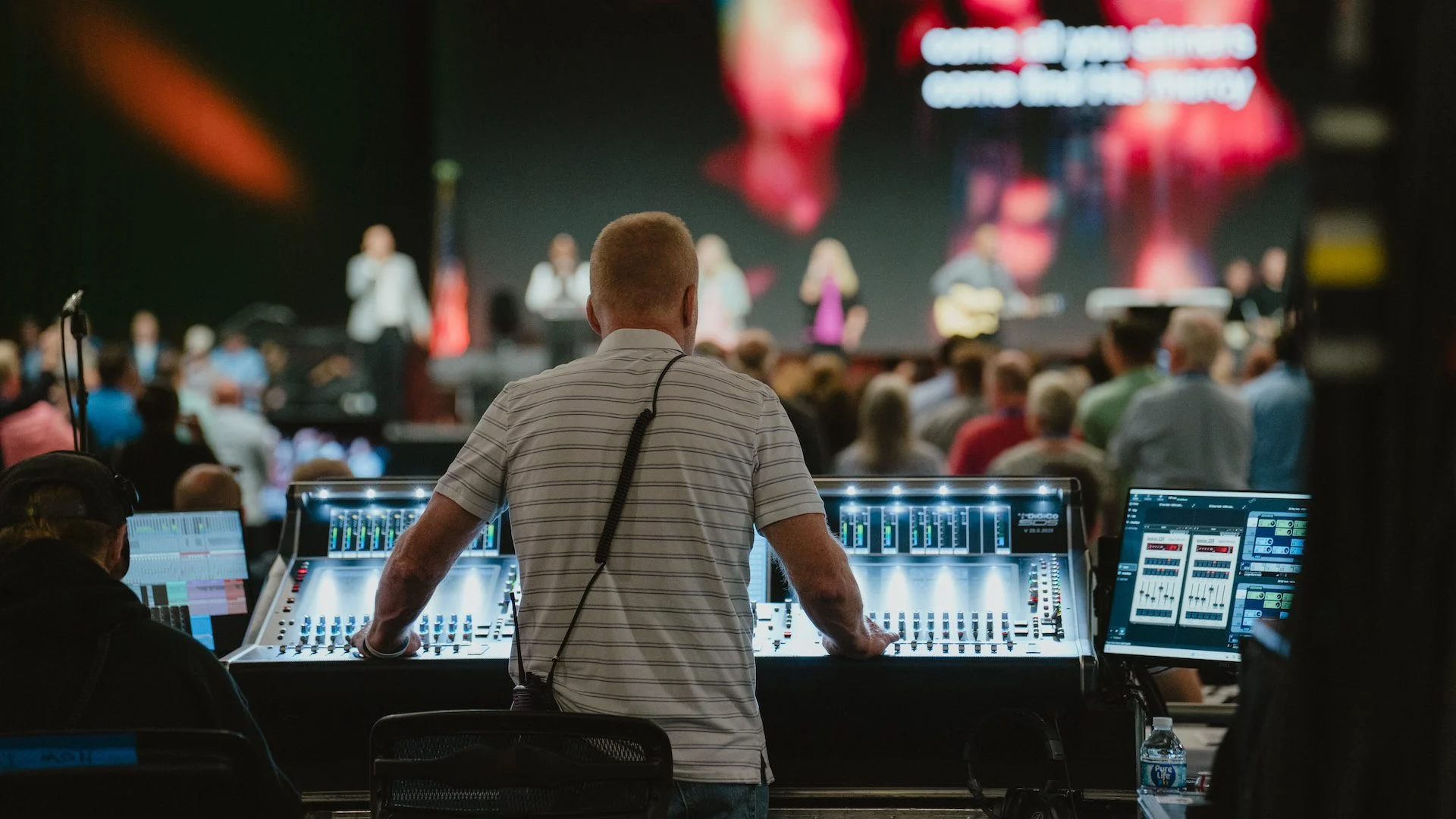
Make the sound right for headphones. The mix that works in a room full of bodies is not the mix that works in earbuds. A separate broadcast feed — even a rough one — is a step change in perceived quality.
Put a human on the other end. Someone whose only job is to be present with the online congregation: replying in the comments, welcoming by name, noticing the prayer request. This is a hospitality role, not a technical one, and it is the role churches most often leave empty.
Close the loop back to the building. Every online service should make the next step obvious and easy: service times, location, what to expect, who to contact. The research says most hybrid worshippers prefer being in the room. Help them get there.
The objection worth taking seriously
“Streaming makes it too easy to stay home.”
It deserves a real answer rather than dismissal, and the data provides one. The people who both attend and watch — the largest group of online worshippers by a wide margin — prefer attending in person by roughly three to one. Meanwhile in-person attendance among younger generations is rising, not falling, in the most digitally saturated era yet.
That said, the concern is not baseless, and the response is not to remove the stream. It is to make gathering worth the journey. The things that get people out of the house are hospitality, relationship, communion, singing together, being known, being needed. None of those are things a stream can replicate — which is precisely why a church that invests in them has nothing to fear from streaming.
If your building offers nothing the stream cannot, the stream is not your problem.
What to do this month
Find out who is actually watching. Not just peak viewers — how long they stay, how many are returning, where they are. Most churches have this data and have never looked at it. You may discover your online congregation is a third the size of your Sunday morning.
Add the eight-second greeting. This week. Measure nothing, just do it.
Fix the audio before the video. Every time. A separate broadcast mix outranks a fourth camera.
Assign one person to be present online. A host, not an operator.
Ask five online participants what it is like. Actually ask. The answers are usually specific, immediately actionable, and slightly uncomfortable.
The thing underneath all of this
There is a congregation gathered around your church that you cannot see, and will mostly never meet. They are sick, they are working, they are caring for someone, they are far away, they are deciding whether to trust you. They are not an audience and they are not a metric.
The question is not whether to stream. It is whether the people on the other end of it are being treated as a congregation or as a coincidence.
Multi-camera production that treats the online congregation as a congregation — vision mixing, live graphics, broadcast audio, multi-platform simulcast, held to a standard that does not wobble at 10:57am — is the whole of our Church Media Production Suite. But you do not need us to start. You need the greeting, the audio, and one person paying attention.
Explore the Church Media Solution, or start with a conversation about what you already have and what is worth changing first.